
The Australian Research and Development Tax Incentive (RDTI) serves as the federal government’s primary support mechanism for private-sector innovation. Jointly administered by the Department of Industry, Science and Resources (via AusIndustry) and the Australian Taxation Office (ATO), the program delivers substantial tax offsets to encourage Australian companies to invest in scientific and technological research.
For Melbourne’s growing technology, biotechnology, medical technology, engineering, and advanced manufacturing sectors, the RDTI is a critical source of non-dilutive capital. Whether developing novel clinical molecules in Parkville, architecting software platforms in Cremorne, or engineering manufacturing systems in Dandenong, the incentive directly subsidizes the costs of technical experimentation.
However, accessing the RDTI requires navigating complex statutory frameworks under Division 355 of the Income Tax Assessment Act 1997 (ITAA 1997). Working with an experienced business tax accountant ensures these claims are properly structured, as AusIndustry and the ATO continue to increase compliance reviews where vague or unsubstantiated claims expose businesses to clawbacks, 75% administrative penalties, and multi-year audit reviews.
The RDTI offers two distinct benefit tiers based on the aggregated global turnover of the claimant entity:
| Company Profile & Turnover Tier | Statutory Tax Offset & Financial Benefit |
|---|---|
Small-to-Medium Enterprise (SME) Aggregated Turnover < $20 Million | Refundable Tax Offset: Corporate Tax Rate (25%) + 18.5% Premium = 43.5% Refundable Cash Benefit |
Large Enterprise Tier Aggregated Turnover ≥ $20 Million | Non-Refundable Tax Offset: Base Tier: Company Tax Rate + 8.5% Offset Tier 2 (>2% R&D Intensity): + 16.5% Offset |
The SME Refundable Offset: For early-stage and high-growth companies that are non-taxable or in a tax-loss position, the offset is fully refundable as a direct cash refund into the company’s bank account.
The Large Enterprise Non-Refundable Offset: For mature corporate groups, the offset reduces tax payable, with surplus credits carried forward to future financial years based on R&D Intensity.
Under Section 355-25 of the ITAA 1997, claimed R&D activities must meet precise statutory definitions. General engineering problem-solving, standard software development, and routine product testing do not qualify.
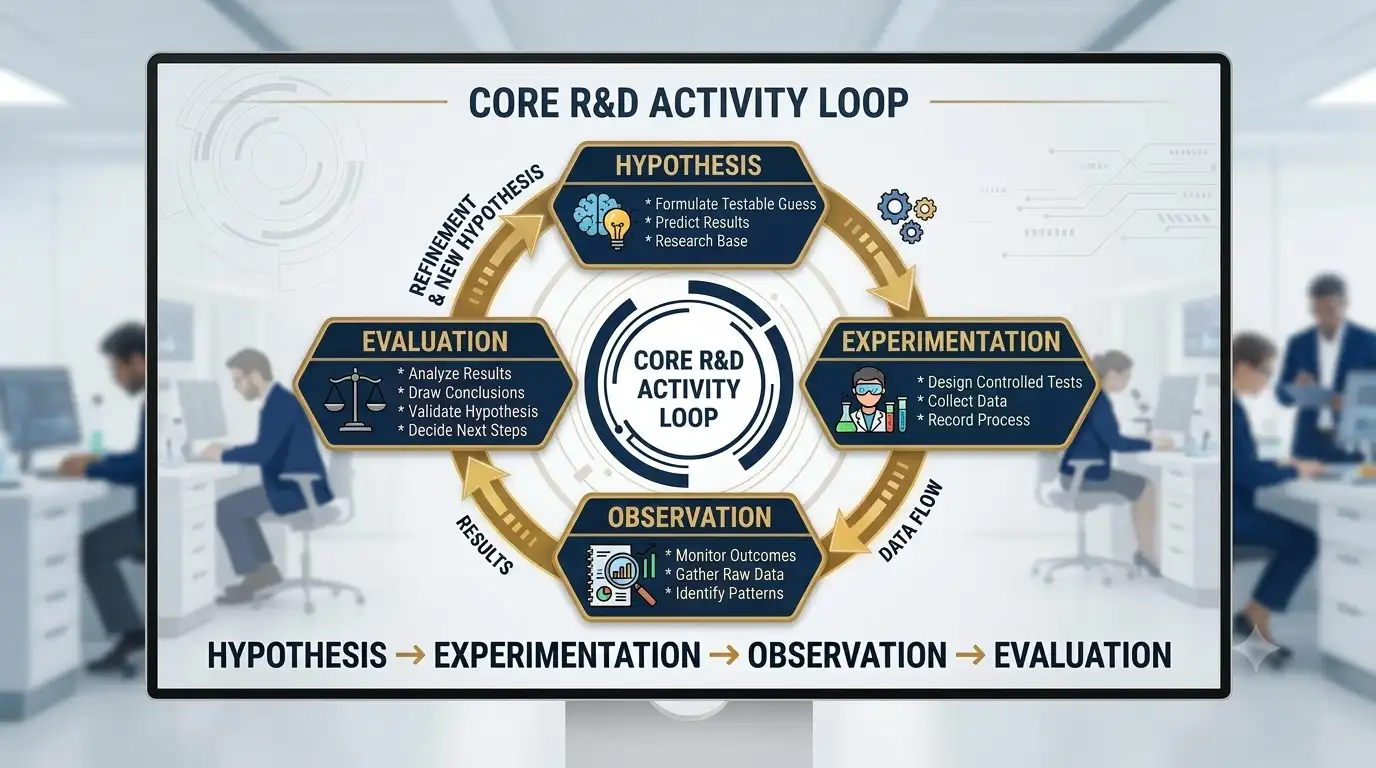
Core R&D Activities (Section 355-25): Systematic progression of work based on principles of established science:
Supporting R&D Activities: Activities that are directly related to, or conducted for the dominant purpose of supporting, a registered Core activity.
To qualify as a Core R&D activity, the outcome of the experiment must not be determinable in advance by a competent professional working in the field, based on current, publicly available knowledge.
Australian tax law explicitly excludes specific activities from being classified as Core R&D, including: market research or consumer surveys; management studies or corporate efficiency audits; routine quality control and standard calibration; mineral prospecting and drilling; and developing software for internal corporate administration.
Our Melbourne R&D consulting team manages the complete program lifecycle:
For Victorian companies undertaking technical research offshore—such as international clinical trials or specialized testing unavailable in Australia—claiming offshore expenses requires a formal Advance and Overseas Finding under the Industry Research and Development Act 1986.
The application must be submitted to AusIndustry before the end of the financial year in which the overseas activities commence, proving that the activity has a direct causal link to an Australian Core activity and cannot be conducted locally due to statutory, geographic, or facility constraints.
Partnering with Ascot Advisory ensures your innovation claims are optimized, compliant, and backed by robust audit-ready evidence.