
While scientific and technical eligibility for the R&D Tax Incentive is governed by AusIndustry, the financial expenditure claimed is audited independently by the Australian Taxation Office (ATO). A company may present an innovative core experimental activity, but if the accounting methods fail to satisfy Division 355 of the Income Tax Assessment Act 1997, the ATO has the statutory power to disallow the expenditure, demand full repayment of tax offsets, and apply substantial administrative penalties.
For CFOs, financial controllers, and business owners across Melbourne, claiming R&D tax benefits requires a strict cost accounting framework. General ledger entries cannot simply be estimated at year-end. Every dollar claimed must be supported by contemporaneous, traceable financial records showing a direct nexus to registered core and supporting R&D activities.
As a registered tax agent and experienced business tax accountant specializing in innovation accounting, Ascot Advisory bridges the gap between technical engineering operations and statutory tax law.
Under Division 355, eligible R&D expenditure is categorized across five distinct cost categories:
| Cost Category | Mandatory Statutory Calculation Rules |
|---|---|
| 1. Direct Employee Labor | Salary, PAYGW, super, workers comp, payroll tax. Requires contemporaneous time records. |
| 2. Contractor Expenditure | Invoiced costs of external technical experts performing work on registered R&D activities. |
| 3. Consumable Materials | Raw materials, components, and reagents consumed or transformed in trials. |
| 4. Asset Decline in Value | Section 355-305 depreciation for physical plant, equipment, and servers used in R&D. |
| 5. Apportioned Overheads | Rent, electricity, software licenses, and lab costs directly supporting R&D operations. |
Labor costs represent the largest expenditure category for most Victorian claimants. The claimable labor cost includes mandatory superannuation, workers’ compensation insurance, and state payroll tax directly attributable to eligible staff. The ATO explicitly rejects blanket percentage estimations; claims must be supported by contemporaneous time-tracking systems, sprint logs, or task-management tickets (e.g., Jira, Asana).
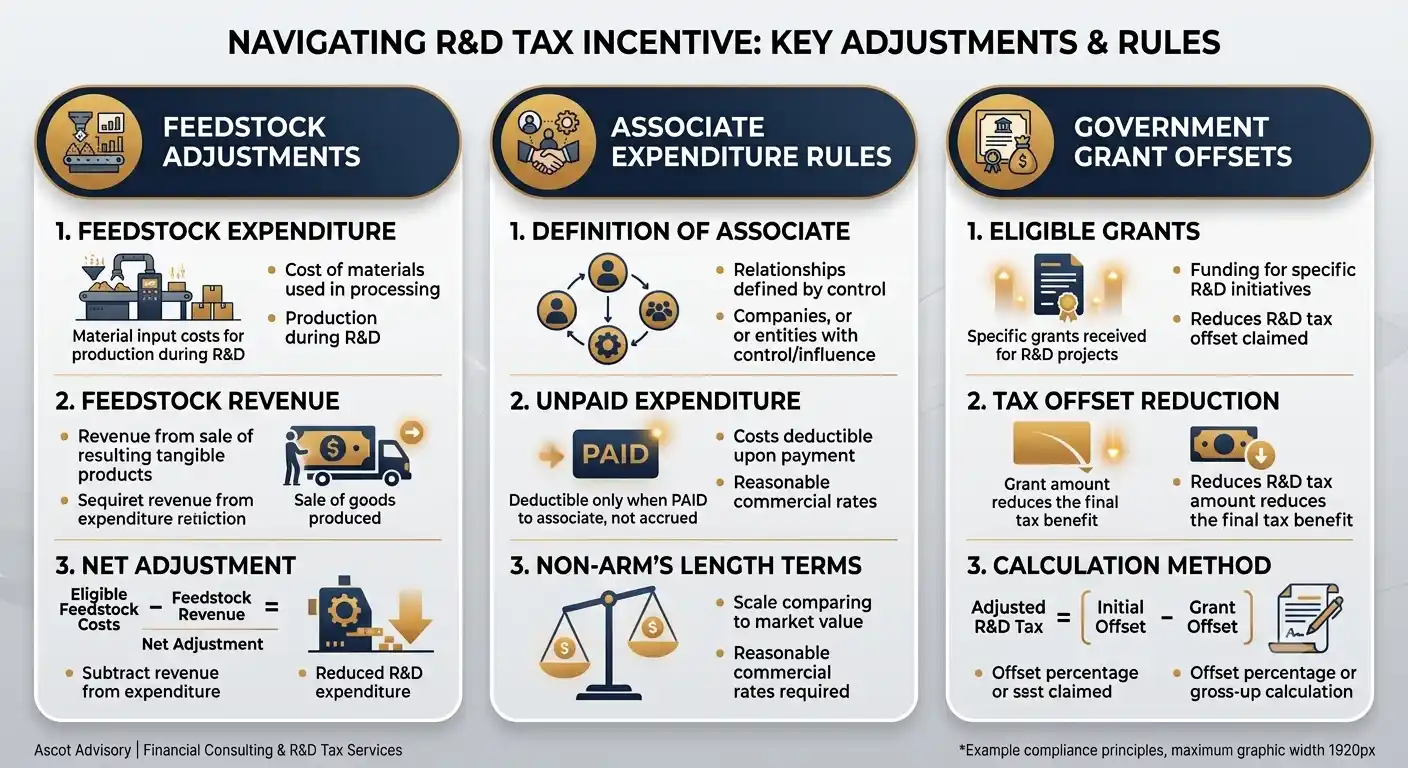
Failing to properly manage statutory adjustments in Division 355 is a leading cause of ATO audit adjustments:
| Statutory Adjustment Mechanism | Technical Impact on R&D Tax Schedule |
|---|---|
| Feedstock Adjustments (Section 355-465) | Increases assessable income when trials produce goods sold or transformed. |
| Associate Expenditure Rule (Section 355-480) | Expenses incurred with related entities are ONLY claimable when PHYSICALLY PAID. |
| Government Grant Clawback (Section 355-440) | Additional income tax applied to prevent double-dipping on publicly funded R&D. |
If an experimental process utilizes raw materials to produce physical goods that are subsequently sold to customers or transformed into marketable inventory, a feedstock adjustment applies to offset the net benefit on those materials.
If R&D expenditure is incurred with a related entity or associate (such as a director, parent company, or related trust), it cannot be claimed in the R&D schedule until the amount has been physically paid in cash. Accruing an expense via intercompany journal entries is insufficient.
If a company receives a non-repayable government grant (such as Accelerating Commercialisation or CRC-P grants) to fund eligible R&D, a clawback adjustment applies an additional income tax of 10% on the grant amount expended on R&D to prevent double-dipping.
Our specialized innovation tax team helps Victorian businesses establish compliant R&D cost-accounting systems:
Contact Ascot Advisory today to ensure your R&D financial claims are accurately calculated and audit-ready.