
The Australian superannuation compliance regime is among the most strictly enforced payroll tax systems globally. Under the Superannuation Guarantee (Administration) Act 1992 (SGAA), all Australian employers are legally obligated to make minimum superannuation contributions into complying super funds on behalf of their eligible employees by the 28th day following the end of each financial quarter.
A widespread misconception among business owners in Melbourne is that paying superannuation a few days or weeks late can be resolved by making a direct payment to the employee’s clearing house or super fund. Under Australian tax law, this is entirely incorrect.
The moment a superannuation contribution is missed past the statutory deadline, the employer has breached the SGAA. The employer cannot rectify the breach through a late payment to the fund; instead, working with an experienced business tax accountant, they are legally required to calculate their liability under the Superannuation Guarantee Charge (SGC) framework, complete an official Section 64B SGC Statement, and submit it directly to the Australian Taxation Office.
Failing to remit superannuation contributions on time triggers statutory compounding penalties:
| Penalty Element | Statutory Calculation & Cost Impact |
|---|---|
| 1. Wage Base Expansion | Recalculated on total Salary & Wages (includes overtime, bonuses, allowances) |
| 2. Nominal Interest | 10.0% per annum compounding daily from the first day of the quarter |
| 3. Loss of Deductibility | All SGC payments and late super are strictly NON-DEDUCTIBLE for corporate tax |
| 4. Part 7 Penalties | Up to 200% of underlying SGC for failure to lodge SGC statements proactively |
During ordinary payroll cycles, superannuation is calculated solely on Ordinary Time Earnings (OTE), which generally excludes overtime hours, shift loadings, and certain performance allowances.
However, under Section 19 of the SGAA, once an SGC shortfall occurs, the superannuation obligation is recalculated on the employee’s Total Salary and Wages. This means employers must pay superannuation on all historical overtime, bonuses, and commission payments, significantly expanding the underlying debt.
Under Section 26-95 of the Income Tax Assessment Act 1997, payments of the Superannuation Guarantee Charge—as well as any late super contributions offset against the SGC—are strictly non-deductible for tax purposes. For an Australian private company taxed at 25% or 30%, this increases the real, after-tax cost of the liability by up to 30%.
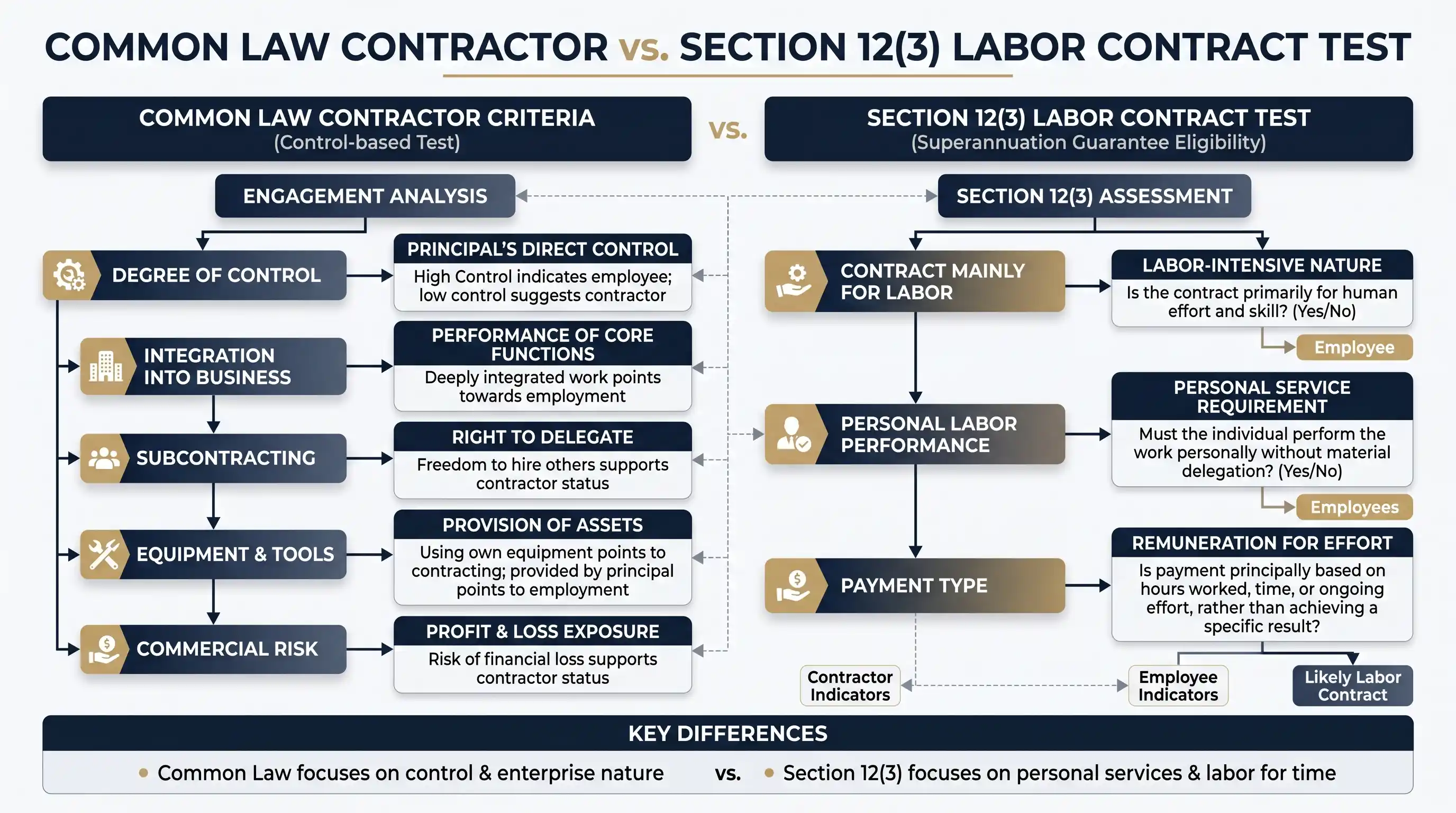
A significant driver of SGC liabilities across Melbourne is the misclassification of independent contractors. Many businesses assume that because an individual holds an Australian Business Number (ABN) or invoices through a proprietary limited company, they are exempt from superannuation.
If the ATO audits an enterprise and reclassifies contractors as deemed employees under Section 12(3), the business faces retrospective SGC assessments spanning multiple financial years, complete with 10% nominal interest, administration fees, and severe Part 7 penalties.
Navigating an SGC liability requires precision forensic accounting and proactive engagement with the ATO:
The ATO’s automated data-matching systems cross-reference STP Phase 2 reports with superannuation fund reporting standards (SuperStream and MATS) in real time. Engaging Ascot Advisory allows business owners in Melbourne to correct historical payroll shortfalls, prepare compliant Section 64B lodgements, and request penalty remissions before audit enforcement begins.