
Under Section 35C of the Superannuation Industry (Supervision) Act 1993 (SIS Act), every Australian Self-Managed Superannuation Fund working alongside their business tax accountant must appoint an approved, independent SMSF auditor to conduct an annual financial and compliance audit before the fund can lodge its SMSF Annual Return (SAR) with the ATO
For SMSF trustees in Melbourne and across Victoria holding digital assets, the annual audit is a rigorous regulatory checkpoint. Because cryptocurrency is characterized by pseudonymous wallet addresses, non-custodial private keys, market volatility, and decentralized trading platforms, independent auditors apply strict evidentiary standards.
An SMSF auditor cannot simply accept a spreadsheet summary of portfolio values. The auditor is legally bound to gather sufficient, appropriate audit evidence verifying fund ownership, market valuation, and compliance with all operational covenants under the SIS Act and SIS Regulations.
Understanding these audit requirements and preparing a clean, substantiated audit package is essential to prevent adverse audit findings, Auditor Contravention Reports (ACRs), and potential ATO sanctions.
During an annual compliance and financial audit, an approved SMSF auditor focuses on four critical compliance areas:
| Verification Pillar | Mandatory Evidentiary Standards |
|---|---|
| 1. Verification of Title (Regulation 4.09A) | Definitive proof that all exchange accounts and wallet public keys are owned exclusively by the Corporate Trustee. |
| 2. Market Valuation (Regulation 8.02B) | 30 June valuations calculated at net realizable market value in AUD using reputable, volume-weighted exchange data. |
| 3. Prohibited Deals (Sections 66 & 109) | Verification of zero acquisitions from related parties and strict arm’s-length commercial terms on all transactions. |
| 4. Investment Strategy (Regulation 4.09) | Confirmation that high crypto allocations are explicitly addressed regarding liquidity, diversification, and volatility risks. |
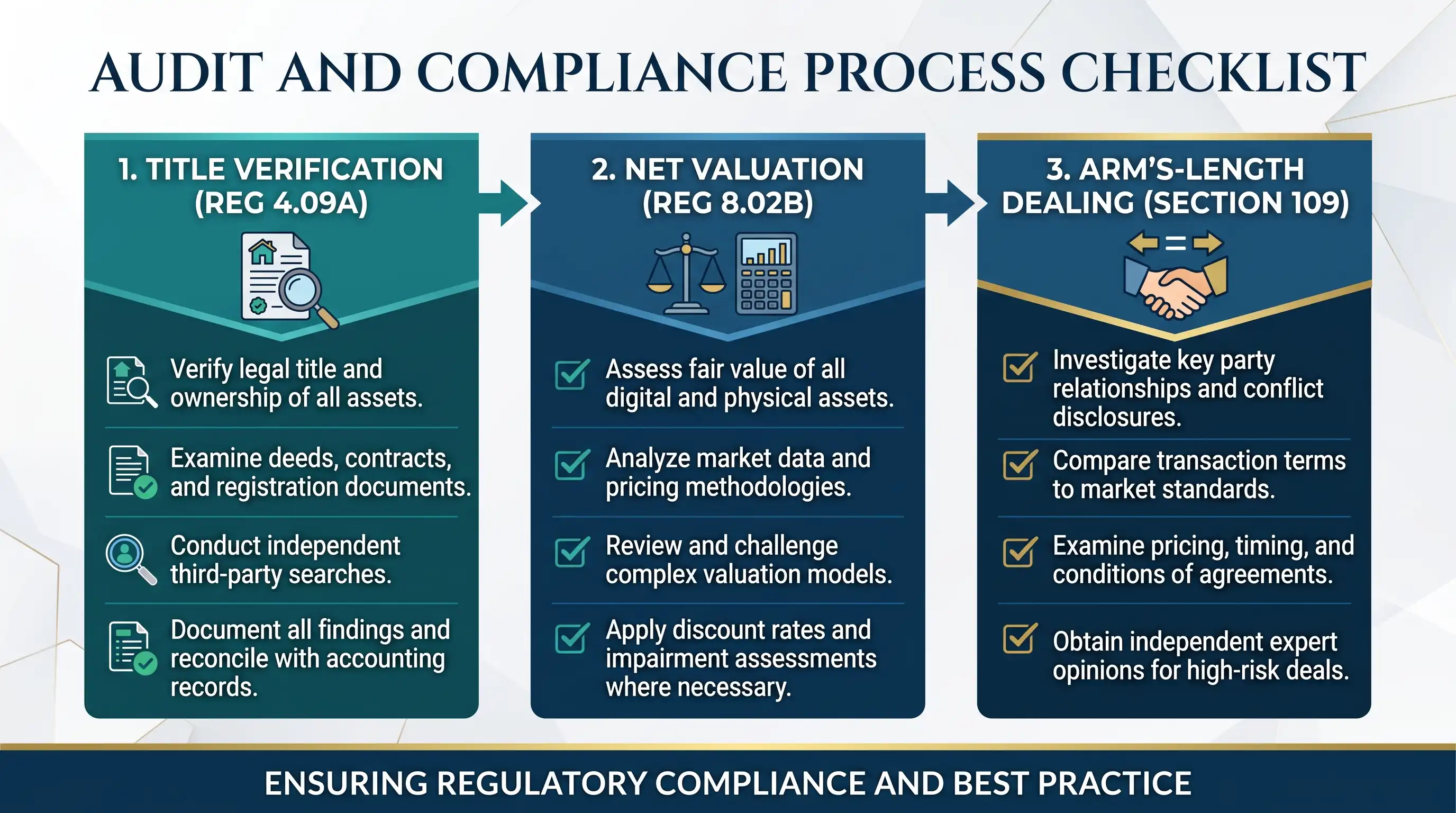
The auditor must verify that the digital assets are held exclusively by the fund’s corporate trustee, completely separate from personal holdings.
Under SIS Regulation 8.02B, all fund assets must be valued at net market value on the balance sheet date (June 30).
For major digital assets (such as BTC, ETH, SOL), valuations must be converted to Australian Dollars using closing rates from major registered Australian Digital Currency Exchanges (DCEs). For lower-liquidity alternative tokens or liquidity pool positions, trustees must provide transparent on-chain pricing histories or decentralized exchange liquidity metrics.
All fund transactions must be conducted on an arm’s-length basis. The auditor checks transaction records to confirm that:
Under Section 129 of the SIS Act, if an auditor discovers a breach of superannuation law that meets specific monetary or statutory thresholds (such as an unrectified breach of the in-house asset rules or failure to prove asset ownership), the auditor is legally mandated to lodge an Auditor Contravention Report (ACR) Form 3088 with the ATO.
| Common Contravention Trigger | Potential ATO Enforcement Action |
|---|---|
| Personal and SMSF crypto mixed on unverified accounts | Mandatory Education Direction (Section 160 SIS Act) |
| Unrecorded hardware wallet public addresses | Administrative Penalties up to 60 units applied directly to directors |
| Failure to substantiate June 30 market values (Reg 8.02B) | Formal Rectification Direction (Section 159 SIS Act) |
| Acquiring crypto directly from fund members (Section 66) | Notice of Non-Compliance (Fund loses 45% of total asset value) |
If an audit issue is identified, our Melbourne audit coordination specialists work with trustees to resolve the contravention before the audit is finalized:
To ensure a smooth, unqualified audit report, our advisory desk implements a structured preparation process:
The annual SMSF audit should not be an adversarial process. By maintaining clean on-chain records, proving physical custody of private keys, valuing assets correctly under Regulation 8.02B, and ensuring all transactions operate strictly at arm’s length, Melbourne trustees can complete their independent audits efficiently and maintain their fund’s compliant standing with the ATO. Contact Ascot Advisory today for expert audit preparation support.