
Discretionary Family Trusts (often termed inter-vivos family trusts) remain a cornerstone of private wealth structuring, asset protection, and tax optimization for high-net-worth families, property investors, and business founders across Melbourne.
When structured properly, a family trust allows trustees to distribute annual trust income across a family group to utilize different marginal tax brackets, protect assets from commercial creditors, and pass down generational wealth without triggering immediate capital gains tax events.
However, the legal and tax environment governing discretionary trusts has changed significantly. The Australian Taxation Office (ATO) has implemented strict compliance frameworks targeting trust arrangements, centered on the enforcement of Section 100A (reimbursement agreements) and Division 7A (unpaid present entitlements and corporate beneficiary loans).
Managing a family trust in Melbourne now requires far more than basic tax preparation. Partnering with a dedicated business tax accountant ensures deep technical expertise in trust deed interpretation, strict compliance with annual trustee resolution deadlines, and proactive structuring to survive regulatory review.
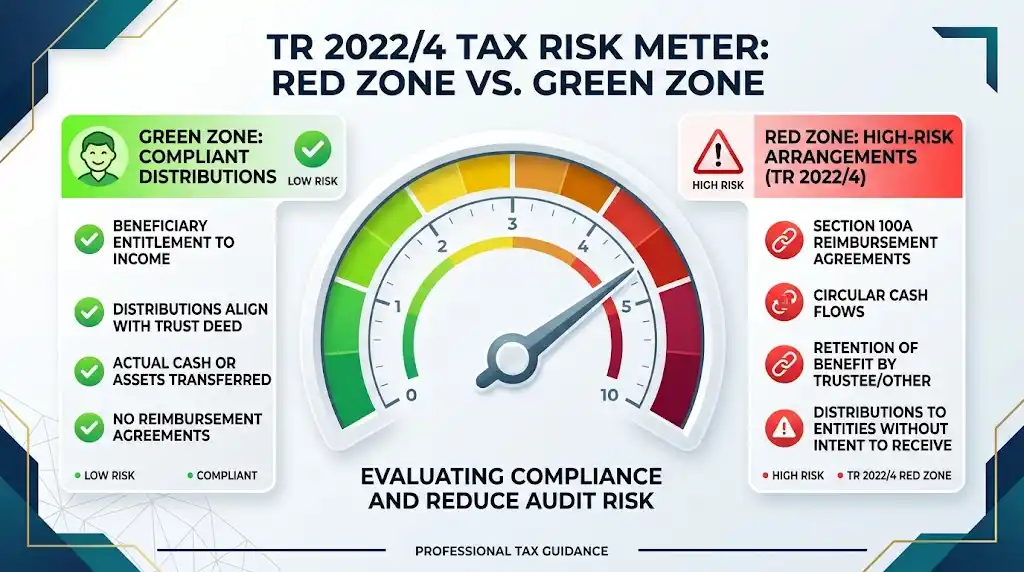
Under Taxation Ruling TR 2022/4 and Practical Compliance Guideline PCG 2022/2, the ATO actively reviews discretionary trust distributions to identify arrangements where trust income is allocated to one beneficiary, but the real economic benefit of that income is enjoyed by another.
| Risk Zone | Distribution Profile & Operational Arrangement |
|---|---|
| Red Zone (High Risk / Targeted) | Trust distributions made to adult children over 18 or elderly relatives with low tax rates, where the funds are immediately gifted back to parent controllers to cover household expenses or mortgage payments. |
| Blue / Green Zone (Compliant) | Trust income distributed to a beneficiary who actually receives, controls, and uses the money for their own benefit, or distributions falling squarely within the statutory “ordinary family or commercial dealing” test. |
If Section 100A is successfully applied:
Our Melbourne private client tax team designs defensible trust distribution frameworks:
Distributing trust income to a corporate beneficiary (commonly referred to as a “bucket company”) is a standard strategy to cap the tax rate on trading profits at the corporate rate of 25% or 30%. However, if the physical cash is retained within the family trust rather than transferred to the company, specific tax rules apply.
| Regulatory Rule | Statutory Execution Requirements |
|---|---|
| Section 109UB / 109PC (Division 7A Treatment) | Treating the unpaid present entitlement as a deemed loan from the company to trust. |
| Section 109N Loan Agreements | Executing a formal 7-year principal and interest loan agreement at benchmark rates. |
| Minimum Yearly Repayments (MYR Cash Requirement) | Making mandatory principal and interest payments by June 30 each financial year. |
Under the ATO’s updated ruling on corporate UPEs (TD 2022/11), where a trustee resolves to distribute income to a corporate beneficiary, the unpaid entitlement is treated as a loan subject to Division 7A. To prevent this UPE from becoming a deemed unfranked dividend:
Under Australian trust law and the precedent set in Commissioner of Taxation v Harmer, a trustee must make a valid, binding resolution to distribute trust income on or before June 30 of the relevant financial year (or by an earlier date if specified in the trust deed).
If the trustee fails to execute a valid written distribution resolution by June 30:
Our Melbourne family trust accounting practice provides a complete annual management framework:
A family trust is one of the most effective tools for building, managing, and passing down family wealth. However, maintaining its protective benefits and tax advantages requires strict, proactive management.
By partnering with an experienced family trust tax accountant in Melbourne at Ascot Advisory, private groups can optimize their distributions, maintain full compliance with Section 100A and Division 7A, and protect their generational assets. Contact us today to schedule your consultation.