
Melbourne and Victoria have established themselves as core hubs for digital asset adoption, blockchain innovation, and modern wealth creation. High-net-worth trustees across Melbourne are increasingly incorporating digital assets into their long-term superannuation portfolios.
However, managing an SMSF holding cryptocurrency requires navigating the intersection of complex on-chain protocols and Australian superannuation law.
Managing investments across decentralized finance (DeFi), proof-of-stake node validation, wrapped tokens, liquidity pools, and non-fungible tokens (NFTs) introduces unique tax challenges under the Income Tax Assessment Act 1997 and the Superannuation Industry (Supervision) Act 1993 (SIS Act).
Treating an SMSF crypto portfolio with standard bookkeeping methods exposes the fund to severe compliance risks, including auditor disqualifications, ATO compliance reviews, and loss of complying tax status.
A dedicated Melbourne SMSF crypto tax specialist and business tax accountant delivers the technical on-chain proficiency, forensic accounting systems, and structural tax knowledge required to build and maintain a compliant, high-performing digital asset super fund.
The Australian Taxation Office applies specific tax treatments across different types of digital asset transactions. Navigating these rules requires accurate on-chain timestamping and correct tax classification:
| Protocol Activity | Statutory Tax Treatment |
|---|---|
| 1. Token-to-Token Trades (e.g., BTC to ETH) | CGT Disposal Event (CGT Event A1): Realized gain/loss based on AUD fair value at the exact timestamp of execution. |
| 2. Staking Rewards & Node Validation Yields | Ordinary Assessable Income: Taxed on receipt at AUD market value. Forms the new cost base for future CGT. |
| 3. Liquidity Pool (LP) Tokens (DeFi) | CGT Disposal & Acquisition: Depositing assets into an AMM pool triggers a CGT disposal of underlying tokens. |
| 4. Wrapped Tokens (e.g., BTC to WBTC) | CGT Event vs. Mere Change of Form: Evaluated under beneficial ownership rules. Generally treated as a taxable CGT event. |
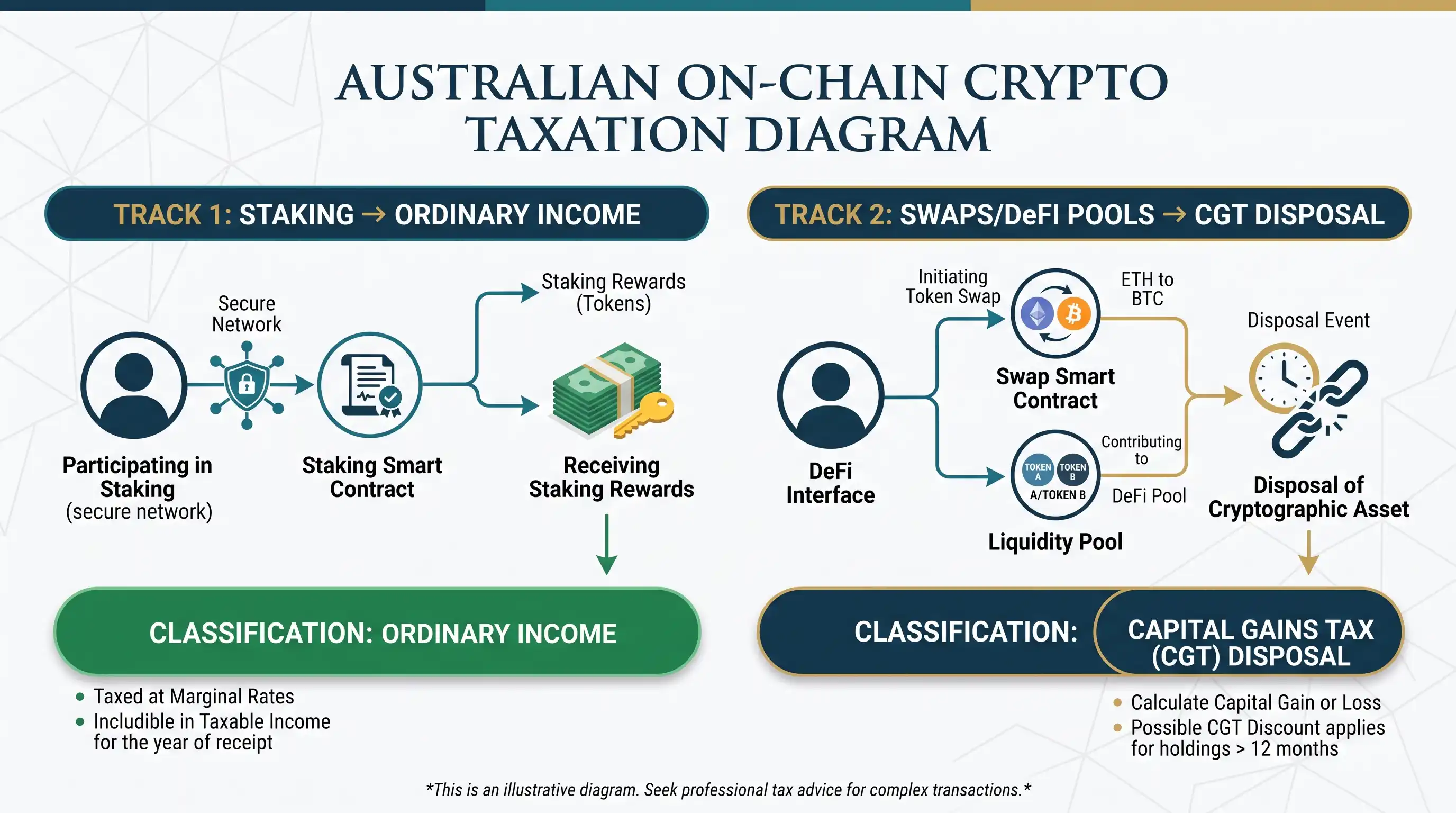
Under ATO guidance, rewards earned by staking crypto assets or running validator nodes are treated as ordinary assessable income upon receipt, rather than capital gains.
The assessable income is calculated using the fair market value in AUD at the precise time the tokens hit the trustee’s wallet. This initial value establishes the asset’s cost base for calculating future Capital Gains Tax (CGT) when the tokens are eventually disposed of.
Participating in decentralized liquidity pools (such as Uniswap or Curve) involves complex tax mechanics:
Operating a resilient crypto SMSF requires robust corporate governance and asset protection structures:
While Australian law permits an SMSF to operate with individual trustees, doing so with a digital asset fund introduces significant risks:
A critical area of risk for digital asset SMSFs is estate planning and key succession. If a trustee holding private keys becomes incapacitated or passes away without a clear succession framework, the fund’s digital assets can be permanently lost on the blockchain.
Our Melbourne advisory practice structures comprehensive digital asset succession frameworks:
The primary financial objective of holding cryptocurrency within an SMSF is transitioning assets into the Retirement Pension Phase:
| Operational Phase | Tax Strategy & Financial Outcome |
|---|---|
Accumulation Phase (Asset Growth) | 10% effective CGT rate on assets held >12 months. Income taxed at 15%. |
Account-Based Pension Phase (Retirement & Drawdown) | 0% tax on ALL realized capital gains, staking yields, and token disposals (supporting pension up to Balance Cap). |
Transfer Balance Cap Strategy (Managing Caps > $1.9 Million) | Balancing high-growth crypto assets across multiple members to maximize tax-free room. |
By balancing asset growth against the statutory Transfer Balance Cap, trustees can realize significant capital gains at a 0% effective tax rate, locking in accumulated crypto wealth to support a tax-free retirement income stream.
Managing a digital asset SMSF in Melbourne requires advisory support that understands both cutting-edge blockchain protocols and Australian superannuation law.
By partnering with a specialized SMSF crypto tax advisor at Ascot Advisory, trustees protect their digital assets, ensure ongoing compliance with SIS Act rules, and structure their portfolios to maximize long-term, tax-efficient wealth creation. Contact us today to arrange a consultation.